The Human Slop Problem: What I Overheard in a MadFest Bathroom Stall.
22nd July 2026
Back to articlesFrankie Coia, Business Director – Digital Strategy and Innovation
Mad Fest 2026 central theme was ‘the human touch’ – not surprising given every meeting you’ve been in in the last three years, you’ve probably heard mention of the importance of a ‘human in the loop’ when it comes to the utilisation of AI. As a result of this theme, there was a somewhat extreme through-line for every talk, which at times made picking which one to go to quite difficult:
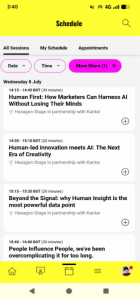
As with most events, the best reviews can often be overheard in the girls bathroom. As the 3-day event came to a close, I overheard one attendee ranting to her friend: ‘I am sick and tired of us talking about authenticity and human connection… WE KNOW. We’ve been talking about this for YEARS.’ I left the bathroom stall and every other woman in there was laughing to themselves having overheard this absolute truth bomb. If this is how we’re all seemingly feeling, why are we still having to host conferences telling people to be more human?
The answer may lie in this years headliner, Louis Theroux. Hot off the success of Manosphere, he was there to talk about the evolution of media in his own career (from BBC to podcasting to Netflix), the influence of algorithms on culture and brand safety. He talked a lot about the importance of being a naturally curious person who wants to delve deep into culture and understand it. This is the kind of person that you should find in abundance at every ad agency in the land. Yet, if woman-in-the-toilet is to be believed, we’re worryingly bereft of these independent thinkers.
At one point, in reference to incel culture, Louis asked if anyone had seen the hit movie of the summer, ‘Obsession.’ Of the several hundred people in the audience (every other stage was live-streaming the session), he remarked that ‘a few people’ had put their hands up. How can that be? I’d spent the morning attending talks about how humans understanding culture will be what sets them apart from AI, and yet hardly anyone at this festival for advertising had seen the most-hyped movie of the summer. I found this to be a big glaring red flag.
I recently spoke to Lucy Irving, Head of Cultural Strategy at ITV, who told me the best thing to do to understand culture is to just ‘go out in the world and observe’, rather than to doom-scroll ‘online culture’, because what’s happening on TikTok isn’t real life. A talk from Imme Ermgassen, co-founder at drinks company Botivo, and Shona Campbell, Chief Marketing and Growth Officer at Ottolenghi, demonstrated the importance of this idea when it comes to brand collaboration and product ideation.
Prior to the two brands’ collaboration, Imme mentioned she was going to a children’s party when she found out Yottam Ottolenghi was going to be in attendance. Not one to miss an opportunity, she attended the party and poured everyone a drink of Botivo, hoping to catch Yottam’s attention. Not exactly a subtle play, but one that worked. She knew her audience, and she knew Ottolenghi’s audience; they existed in perfect harmony together at that party. A conversation began around the flavour profiles that go into a Botivo drink, and Ottolenghi felt the two brands would be a good match. They eventually went on to collaborate on a brand new Botivo product together.
The partnership was built around feasting, pleasure-seeking and indulgence. Literally just the act of people coming together and sharing, as Imme did at that first party where the connection was made. She didn’t observe it as a trend on TikTok, nor did she have to ask AI who the perfect brand partner would be. She lived and breathed it, participating in the culture she wanted the brand to contribute to.
That sentiment was really hammered home over the three days: living in the real world and understanding culture will be how humans can either work with, or against, the machines. AI may be able to scan the internet, but it can’t walk down the street or attend a children’s party. Or at least, that was going to be my argument until I attended a talk from Snapchat, who recently dropped their rival to Meta Glasses, SPECS.
The glasses are designed to help you in the real world, like when you’re cooking or checking your car’s engine for faults. If AI is already capable of observing the real world to make useful recommendations, it’s not far-fetched to imagine a world in which it uses real-world observations in combination with online-world insights to draw up more ‘human-led’ brand strategy. Only time will tell if AI will be better than humans at real-world observation, but the best thing you can do to prepare yourself is to actively start observing and participating in culture yourself.
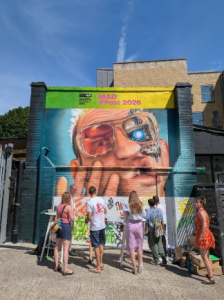
Global Street Art’s mural activation invited participants to try their hand at graffiti. This was an especially effective activation after walking through a tunnel dedicated to ad tech. The juxtaposition was stark.
Nano Interactive also leant in to the human touch theme, inviting tarot card reader, Sarah, to do readings with participants. After my scarily-accurate reading, we had a lovely conversation about life and work. We cannot forget that this industry thrives and relies on people connecting and sharing perspectives. If AI continues to take hold and mass-redundancies continue to be made, who will be left to attend the conferences dedicated to the human touch? Will the robots be doing tarot card readings and spray painting their tags on walls?
Another talk from Reddit had us hearing about the human touch in the online world. Unfortunately, the irony cannot be lost that the humanness of Reddit is being delightfully sooked up by all the LLMs. One of Reddit’s community moderators, John McLusky, said that every subreddit was ‘like a city’; the great but worrying thing is that those are online cities that the AI can currently walk down.
The more we participate online in communities, sharing our personal thoughts, feelings and observations, the more AI will be able to mimic that human touch… the very thing that we’re reassuring ourselves by saying they can’t. John also mentioned that the absolute worst thing a brand could be on Reddit is ‘inauthentic’ – the very real people on Reddit can spot posts written by AI and conceited attempts to shoe-horn brand messaging into communities.
Thinking back to the review of the woman in the bathroom stall, my biggest takeaway of the 3-day event is that we have to give meaning and context to the often empty, repeated words we say i.e. the human slop we consistently find ourselves regurgitating about human connection and authenticity. You cannot talk about the importance of cultural relevancy if you’re living in a marketing bubble and relying on webinars to tell you that coffee is the new beer or that run clubs are the new going out. You can’t talk about the importance of human connection if you spend most of your life behind a screen doomscrolling. ‘Authenticity’ has no meaning in a world where brands pretend to act like real people online, or worst yet, when their words have been written by a LLM.
Instead of repeating what you’ve heard before from other marketers, go out into the world and observe something that no one else has. Make the connection between two brands that AI can’t make because you attended a party, go see the most popular film of the summer and speak to someone about how it made you feel, try your hand at spray painting to understand artistic integrity, or have your tarot cards read to connect with why witchcraft has gone mainstream.
It’s time to stop the regurgitation of human slop, because the sentiment extends far beyond the bathroom stall at Mad Fest.