Tell Me a Bid-Time Story: The Importance of Communication in the AI Era
15th June 2026
Back to articlesHannah Lee, Paid Search Assistant
Last month, I attended SEM Stories and learnt so much about how people were getting innovative in the performance marketing scene to get better data, better bids and a better understanding of the (very quickly) evolving ways people search. Like all events these days, there was a running joke about how all the talks were about AI: how to adapt your strategy to AI agents, how to use AI in day-to-day work, how to replace your entire team with AI (not happening).
It makes sense – AI is the new thing, the word everyone’s talking about, the big change happening across all industries right now. From Google launching Ask Advisor to automating scripts with ChatGPT, the activation part of PPC is quickly being automated away right before our eyes.
What’s interesting though, is how people are responding to this change. The talks at SEM Stories revolved around turning to skills beyond just activation: statistics, agent-assisted data analytics, automation, and high school maths.
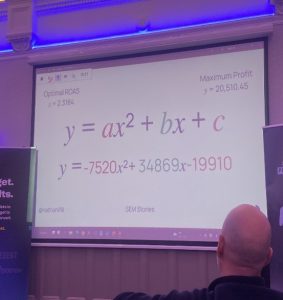
POV you’re taking A level maths
As AI becomes a part of all our lives, Search is becoming more data-driven, more technical, and more complex. In light of this, I’d argue that it’s therefore all the more important to make technical communication and data storytelling a central part of PPC.
Unboxing the Black Box
As more of Search itself is becoming more technical, it’s going to become more of a black box for clients – they know what they put in and what they’re supposed to get out of it, but it’s tough to wrap your head around its inner workings. And that can become a major barrier when it comes to working with clients to adapt a more data-forward strategy.
More importantly, when the inner workings of PPC become hidden from other marketing teams, collaborative opportunities can be missed in terms of how PPC can be used in tandem with other channels.
Communication needs to be clear and accessible not just to convince clients to take on new strategies and tools, but also to ensure cross-team collaboration is effective for everyone.
Telling a Story
At the same time, as we collect more granular data and analyse this data through complex models and processes, we need to make sense of all these numbers and figures through data storytelling.
Data storytelling is defined by Harvard Business School as “the ability to effectively communicate insights from a dataset using narratives and visualisations”. It’s used to ground abstract data in real-world knowledge and inform better decision-making.
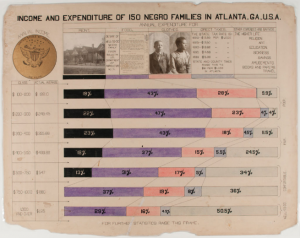
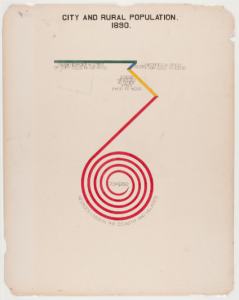
Data visualisations by W.E.B Du Bois & his students in 1900, demonstrating the success of Black Americans in spite of systematic racism in the US source
On the client side, this helps clients better understand their audience and competition cohesively in the search space, bringing them business insights beyond just marketing. Similarly, data storytelling helps marketing teams collaborate more seamlessly – other teams can understand the knowledge and insights in Search and inform their approach to targeting and planning.
As Thomas Davenport puts it, “data is worthless if you don’t communicate it”. Getting more sophisticated data doesn’t guarantee results, communicating it effectively does.